

Understanding Risk Grades
The RiskScore
Section titled “The RiskScore”A client’s credit standing is presented as a RiskScore - a grade from A1 (strongest) down to F (weakest), backed by a numeric score out of 850.
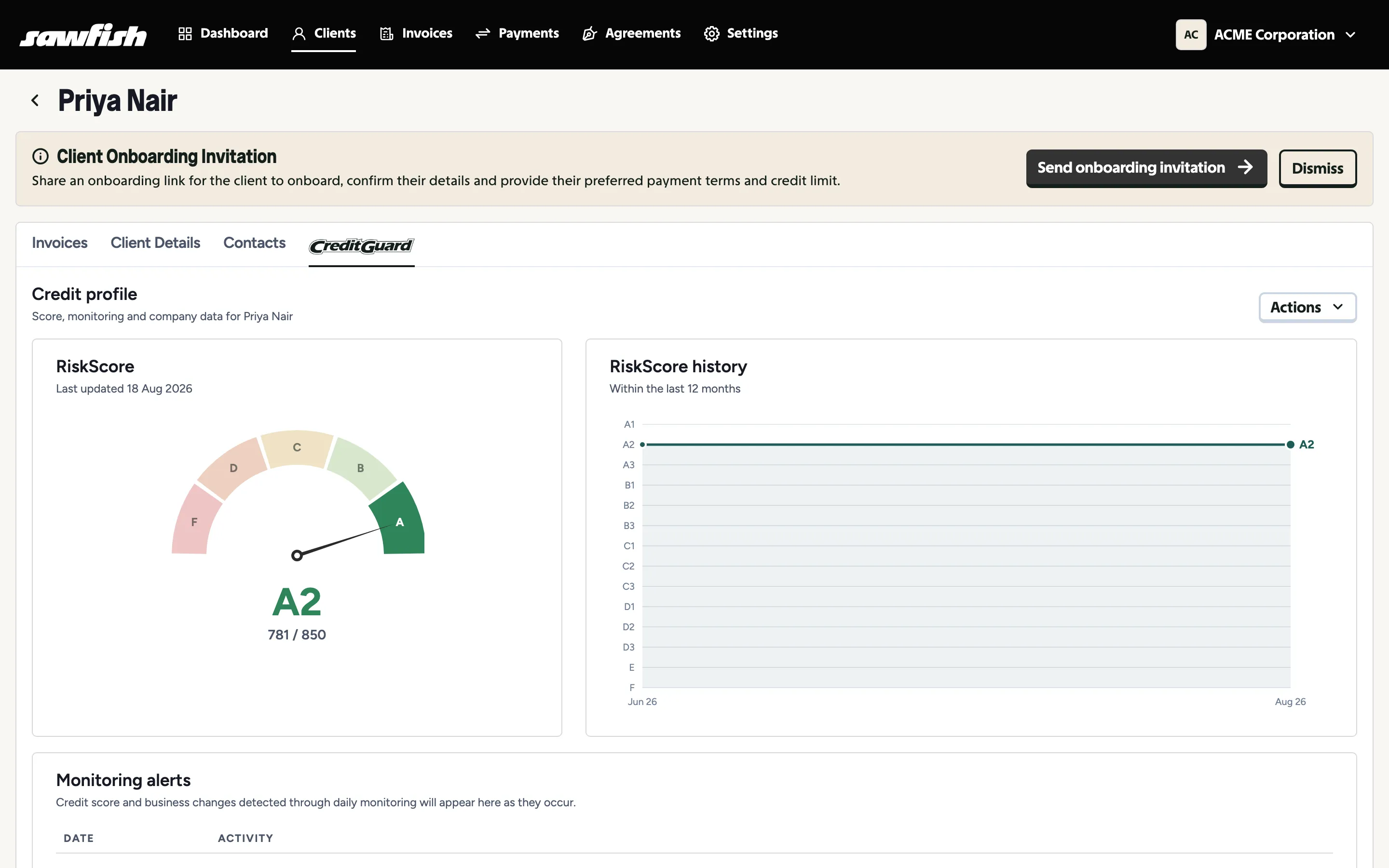
The gauge places the client in one of the bands:
| Band | Meaning |
|---|---|
| A (A1-A3) | Strong credit position - low risk of default |
| B (B1-B3) | Sound - minor risk indicators |
| C (C1-C3) | Moderate risk - trade with sensible limits |
| D (D1-D3) | Elevated risk - consider tighter terms, deposits, or prepayment |
| E / F | High risk - extending credit is not advisable |
RiskScore history
Section titled “RiskScore history”The history chart plots the client’s grade over the last 12 months, so you can tell a stable C from one that’s been sliding out of the As. Monitoring events are the usual cause of movement - each one is recorded under Monitoring alerts on the same tab.
Beyond the score
Section titled “Beyond the score”The credit profile also includes:
- Business information - ABR and ASIC registration data: registered names, ABN and ACN, entity status and type, GST registration, and registered address.
- Directors and officeholders - the current ASIC officeholders, with dates of birth, addresses, and appointment dates.
- Shareholding - the share structure and every shareholder with their holding and percentage.
- Historical credit score movement - the underlying score events.
See Inside the credit profile for the full rundown.
Unlock Full Credit Report retrieves the complete bureau report, and Download report saves the credit report as a PDF.
Putting grades to work
Section titled “Putting grades to work”- Set each client’s credit limit (on their details tab) with their grade in mind - the dashboard’s Credit Limit Tracking widget does the day-to-day watching.
- For D-and-below clients, consider payment up front: Sawfish agreements can require a payment method before work starts.